Continuity risk
Critical client and process knowledge was concentrated among a limited number of employees and owners. Absence immediately meant lost context.
Project case · Knowledge continuity
For a professional services firm, we built a living Company Memory that brings together documents, workflow knowledge and employee expertise. Six users can now ask the agent about clients, engagements and company processes while retaining source control, access rules and an audit trail.
Sector
Professional services
Users
6 employees
Core objective
Knowledge continuity
Data source
Google Drive + workflows
The system in practice
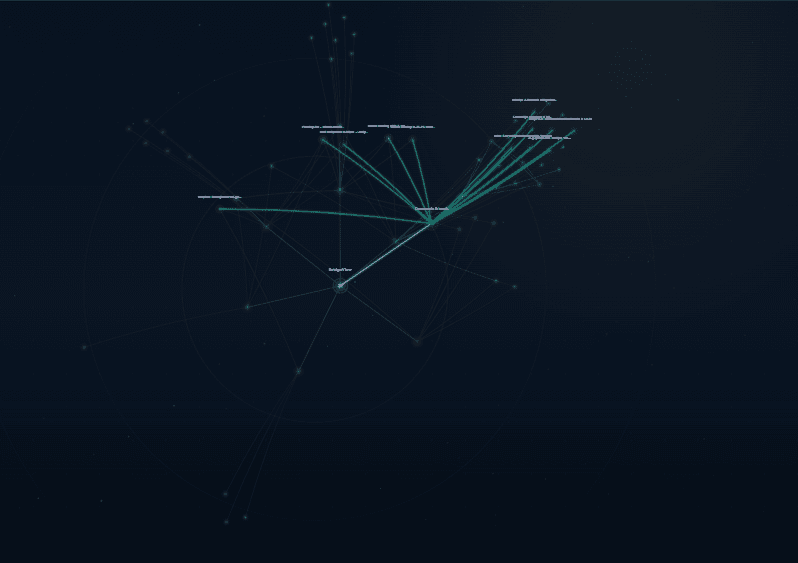
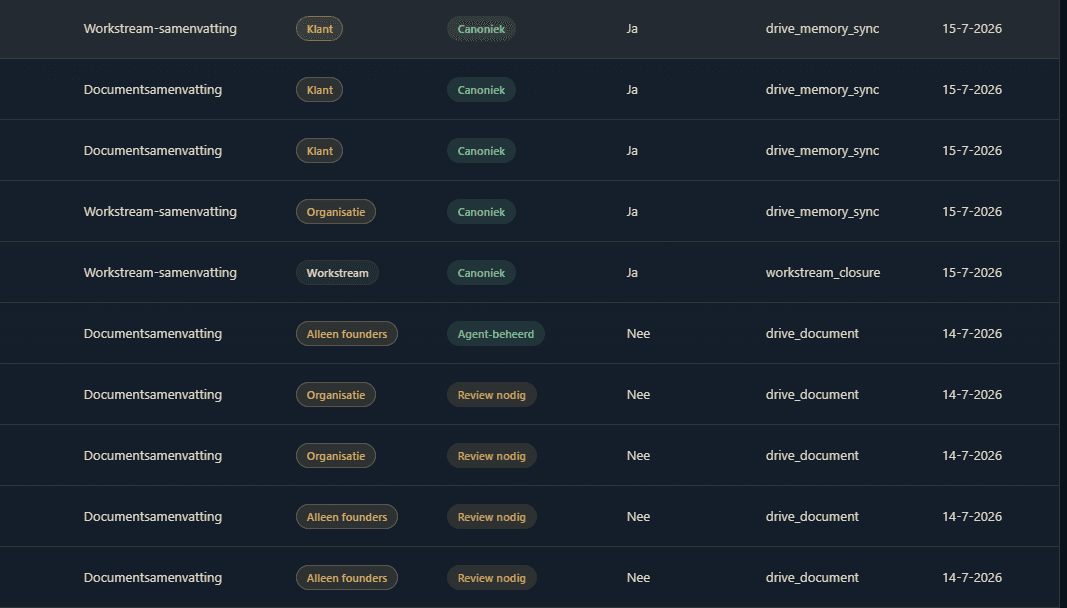
The knowledge graph makes relationships between documents, clients, workstreams and processes visible. In the vault, each knowledge item retains its audience, status and source.
Executive summary
The breakthrough was not simply better search. For the first time, the organisation gained one operational memory connecting documents, client context, process knowledge and lessons from completed work.
Critical context is therefore no longer dependent on one experienced employee being available. The agent makes that knowledge accessible when needed, while governance determines which information is reliable and visible.
Starting point
Critical client and process knowledge was concentrated among a limited number of employees and owners. Absence immediately meant lost context.
New employees received documents and fragmented explanations, but not the full story behind clients, decisions and working methods.
Valuable lessons from engagements and workflows were not systematically reused and disappeared into heads and folders.
The intervention
The solution connects four layers into one working system. Each layer addresses a different part of the knowledge problem.
01
Existing Drive documents and knowledge from completed workflows.
02
Summaries, relationships and context around clients, processes and engagements.
03
Status, scope, source, human review and a growing audit trail.
04
One conversational interface that retrieves only context permitted for each user’s access level.
The shift
Knowledge lived in heads and separate folders.
→Knowledge is systematically captured in one connected organisational memory.
Colleagues needed to know who to ask.
→The agent retrieves relevant context about clients, engagements and processes.
Onboarding started with searching and verbal handovers.
→New employees gain a coherent starting point for how the company operates.
Context disappeared after work was completed.
→Completed workflows enrich memory and build an audit trail.
Governance by design
Leading knowledge that the organisation and agent may use as reliable context.
Current document knowledge maintained by the agent pipeline and made available when safe.
Uncertain or sensitive information remains outside agent context until reviewed by a person.
Each item is linked to the organisation, a client or workstream, or restricted to founders. The agent builds its answer from the signed-in user’s permissions, so different roles can receive different context.
Operational effect
Six users now work from the same accumulated company context. Knowledge remains available during absence or departure, onboarding gains a much clearer starting point and each new workflow can enrich collective memory. At the same time, a verifiable audit trail captures where knowledge came from and how it is used.